



A brief history of the material that has revolutionised the history, the life and people’s mind: plastic
HISTORY OF PLASTIC

Parkesina
The first kind of artificial plastic called parkesina was created in 1856 by the English chemist Alexander Parkes.
In 1862 at the International Exhibition of London and in 1867 at the Exposition Universelle of Paris he showed a series of objects made of this semisynthetic resin which recalled ivory.
Celluloid
After a number of experiments with parkesina, the American typographer John Wesley Hyatt patented the celluloid in 1869.
To push him in the research of this new material was a tender promoted by the company Phelan and Collander, manufacturer of billiard balls, in which a ten thousand dollars reward was offered to whom would had been able to develop a substance replacing ivory, which was becoming scarce.
Firstly, celluloid was widely used by dentists as a substitute of the expensive vulcanised rubber for getting dental records.


Bakelite
The appearance of a new material, the bakelite, overshadowed the success of the first artificial plastic materials.
This new material will dominate the world of plastic for half a century.
Bakelite was invented by the Belgian chemist Leo Hendrick Baekeland in 1907. Bakelite was the first thermosetting resin obtained by the reaction of phenol and formaldehyde.
By this reaction, we get a resinous product that becomes plastic when heated. Under these conditions, the material can be pressed into moulds in order to get objects of various shapes. By extended the heating into the mould, the material hardens and maintains the shape given permanently.
Bakelite can be coloured and polished, therefore it was soon used for manufacturing domestic electrical appliances, toys, boxes, jewellery, lamps but also car dashboards. Nowadays this plastic is used as an electric insulation material and for pot handles
In 1913 the Swiss Jacques Edwin Brandenberger invented the cellophane, a cellulose-based material produced in very thin and flexible sheets. It is a transparent and impermeable material which is soon applied in the packaging field. The word cellophane, by now in common usage, coined by its inventor, was created by combining the words “cellulose” and “diaphane” (letting the light pass through and see through it).
In the ’20s began the first attempts to create plastic material from oil as “raw material”. In 1935 the American chemist Wallace Carothers synthesized, at a chemical laboratory of Dupont, the textile fibre today known as nylon (polyamide). This material marked the rising of “synthetic fibres” and will be largely used in the textile industry: from tights to parachutes.
PET
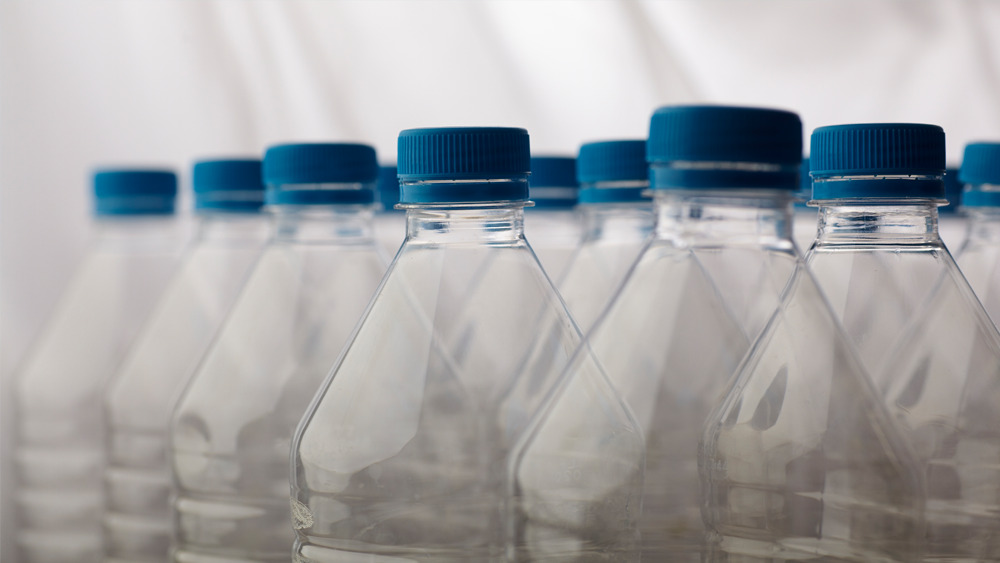
A few years later Rex Whinfield and James Tennant Dickson patented in England the polyethylene terephthalate (PET). The use of PET spread after the Second World War and it was used for making parachutes, sweaters and shirts that do not have to be ironed. This material entered the world of food packaging in 1973, when the inventor and prolific American engineer Nathaniel Wyeth (Du Pont), undertook the challenge of finding a way to produce ginger bottles without using the glass.
According to Wyeth it was a challenge that was won only after years of tests, patenting in 1977 a new method of producing plastic bottles. His solution consisted in using a special mould able to lengthen the fibres so that the molecules would align making the material stronger. The bottle invented by Wyet, which was light, impact-resistant and transparent, is nowadays the standard for mineral water and drinks packaging.
The "years of plastic"
The “years of plastic” began officially the 11th March 1954, when Giulio Natta, future Nobel Prize for Chemistry (in 1963), wrote in his diary: «Made the polypropylene».
The new product, later called “Moplen”, was used for producing everything: from dishes to car components to bowls and toys. During the “economic miracle” in the 60’s, plastic invaded Italian people’s home with objects that look polish, smooth, modern and above all coloured. These objects were available at an “affordable” price and no longer for the sole rich people.
From “mass” plastic material we arrived at the so-called technopolymers or polymers for engineering, having resistance and rigidity features such as to use them instead of the traditional metals. One of these is the polycarbonate. Its performances are higher than average and it is used in several fields such as: optics for spectacle lenses, transport for helmets and light covers, military for bulletproof vests and riot shields, buildings for coverings and windows etc…

Although plastic is now recognised as a “mature” material, the 90’s have been marked by important technical developments in order to meet needs which are constantly increasing in modern manufacturing:
- the safety of the products;
- low environmental impact;
- durability;
- practicality and lightness;
- biocompatibility;
- recycling.
As a consequence, in the 90’s, the transparent or silver multilayer film is created. It protects the products against gases offering a good solution against the absorption of humidity and protects them from oxygen, light and external odours extending in this way their preservation and freshness.
“Our era will be remembered as the era of polymers” said the Nobel Prize Paul John Flory. “The future belong to technoplymers and special polymers which will be created maybe in smaller quantities but will be essential for the human progress”
Plastic is a material that we know very well and that we have been treating for more than 45 years.
Our goal is to educate on plastic recycling, providing innovative solutions to enhance this type of waste.